
Summits | Meetings | Publications | Research | Search | Home | About the G7 Research Group

|
Summits | Meetings | Publications | Research | Search | Home | About the G7 Research Group |
|
GEAC 2025
Gender Equality Advisory Council Impact Assessment Report
The Gender Equality Advisory Council (GEAC) was first established under Canada’s G7 Presidency in 2018 as an independent body to advise G7 leaders and ministers on advancing gender equality in the G7 and beyond. GEAC has since become an established feature of the G7.
During its 2025 G7 Presidency, Canada conducted an impact assessment of GEAC to understand how it has shaped G7 outcomes to advance gender equality, to review working methods, and to capture best practices. The assessment, which focuses on the 2018 to 2024 period, includes the following findings:
GEAC has helped ensure that gender equality stays on the G7 agenda.
There was a direct link or strong correlation between GEAC recommendations and G7 commitments in several instances, most notably in the establishment of the G7 Dashboard for Gender Gaps, which shows that GEAC has played a positive role in advancing gender equality outcomes in the G7.
There has been substantial overlap between GEAC recommendations and G7 commitments more broadly, which shows a correlation between GEAC and G7 efforts.
The factors contributing to GEAC’s success include G7 Presidency priorities, timely support provided by the G7 Presidency, and access to G7 decision makers.
The mere fact that GEAC is still being convened—seven years after it was first created—demonstrates some level of success and the G7’s commitment to gender equality during this time.
“Over the years, the reflections of the GEAC have provided essential guidance, improving the G7’s ability to promote effective commitments and policies. This collaboration has strengthened the G7’s role as a key player in the global effort to improve the conditions and lives of women and girls.”
— Eugenia Roccella, Italy’s Minister for Family, Natality and Equal Opportunities
The objective of the impact assessment was to take stock of GEAC’s impact over the past seven years and review its working methods to capture best practices and develop a set of recommendations to further strengthen GEAC as a vehicle for advancing gender equality in the G7. The assessment sought to answer the following broad questions:
What role has GEAC played in terms of G7 gender equality outcomes?
What are GEAC’s strengths and challenges?
How can GEAC best be supported to ensure the effective implementation of its mandate?
The assessment’s findings and recommendations are presented in this report for consideration by future G7 presidencies.
The Government of Canada conducted the assessment between April and July 2025. The assessment was based on:
Virtual interviews with 40 stakeholders (see annex for questions)
A written survey
A desk review analyzing G7 leader-level outcome documents, GEAC recommendations and existing data and research on G7 gender equality commitments
Stakeholders included G7 government officials from former GEAC secretariats and sherpa teams, former and current GEAC chairs and members, representatives of the Women 7 (W7) G7 engagement group, an independent consultant who supported two GEAC secretariats, and a member of the University of Toronto’s G7 Research Group.
Many factors shape G7 outcomes, including those related to gender equality. Therefore, even when a GEAC recommendation is reflected in a commitment in a G7 outcome document, it can be difficult to demonstrate causation versus correlation, as the commitment may also reflect a broader G7 priority.
The first time G7 leaders addressed gender equality as an issue was at the 1990 summit in Houston, U.S.A., and the first time they made a gender-related commitment was at the 1996 summit in Lyon, France. The leaders’ attention to gender equality increased over the years, and, in 2018, they made a record 82 gender equality commitments at the G7 summit in Charlevoix, Canada.2
That year, Canada’s G7 Presidency made gender equality and women’s empowerment one of its 5 overarching priorities. GEAC was established to “promote a transformative G7 agenda” and support leaders and ministers in ensuring that gender equality and gender-based analysis were integrated across all G7 priorities, activities and outcomes.
GEAC was set up as an independent advisory body composed of 22 members, including two co-chairs, all participating on an honorary basis. Members were selected based on their achievements, commitment to advancing gender equality and capacity to influence public discourse. GEAC members were invited to a 90-minute discussion with leaders at the Charlevoix summit, and select members, depending on their expertise, were also invited to participate in parts of the ministerial meetings organized throughout the year.
GEAC was supported by a dedicated secretariat co-located with the sherpa office, and staffed by 5 government officials. The secretariat was an essential link between GEAC and Canada’s G7 Presidency, and supported GEAC meetings, its review of G7 outcome documents, its members’ participation in G7 meetings, and the development of its recommendations.
Successive G7 presidencies continued to convene GEAC (except in 2020, when there was no summit). GEAC thereby became an established feature of the G7, with terms of reference and multi-year membership appointments to ensure that a coherent approach to gender equality is taken across G7 presidencies. In 2023, G7 officials agreed on formal terms of reference, which state that GEAC “is to be convened under each G7 Presidency as an advisory body to the Presidency on issues of gender equality and the empowerment of women and girls in all their diversity.” At the Carbis Bay and Elmau summits, leaders also indicated that they intended to convene GEAC as a standing feature of all G7 presidencies. This establishment of GEAC points to the value that G7 members place on it as an important feature of the G7 Presidency cycle.
Since 2018, GEAC membership has ranged between 16 and 35 individuals. Its recommendations have varied over time, and have generally become more targeted. For example, in 2019, GEAC focused on legislative reform, and in 2021, its focus was recovery from the COVID-19 global pandemic. The approach taken in 2018—to have GEAC attend G7 meetings—continued, but has become increasingly less systematic and more selective over the years. For example, recently, the Presidency has invited members to the gender equality ministerial meeting only, or it has invited only the chair to meet with the Presidency’s leader to present GEAC’s recommendations.
The G7 Research Group,3 based at the University of Toronto, tracks G7 leaders’ commitments, including those related to gender equality, and has demonstrated how the G7’s attention to gender equality has varied over the years. Although the first gender equality commitment appeared in 1996, gender became a regular agenda item starting in 2009 (except in 2020). Measured as a percentage of the total number of leader-level commitments, the gender equality share was initially low, but increased steadily from 2013 and peaked in 2018 and 2019. Between 2021 and 2024, leader-level commitments related to gender stabilized at 6% to 8% of the total number of summit commitments. In 2016, the G7 began releasing stand-alone documents on gender equality, but this practice ended after 2019.
The following graph excludes the years when leaders did not make any gender equality commitments. It shows the number of gender equality commitments (on the left side of the graph), as well as their percentage of all commitments made that year and the G7’s compliance with the gender equality commitments (on the right side). The G7 Research Group defines commitments as publicly and collectively made statements of intent by summit members that are discrete, specific and future-oriented.
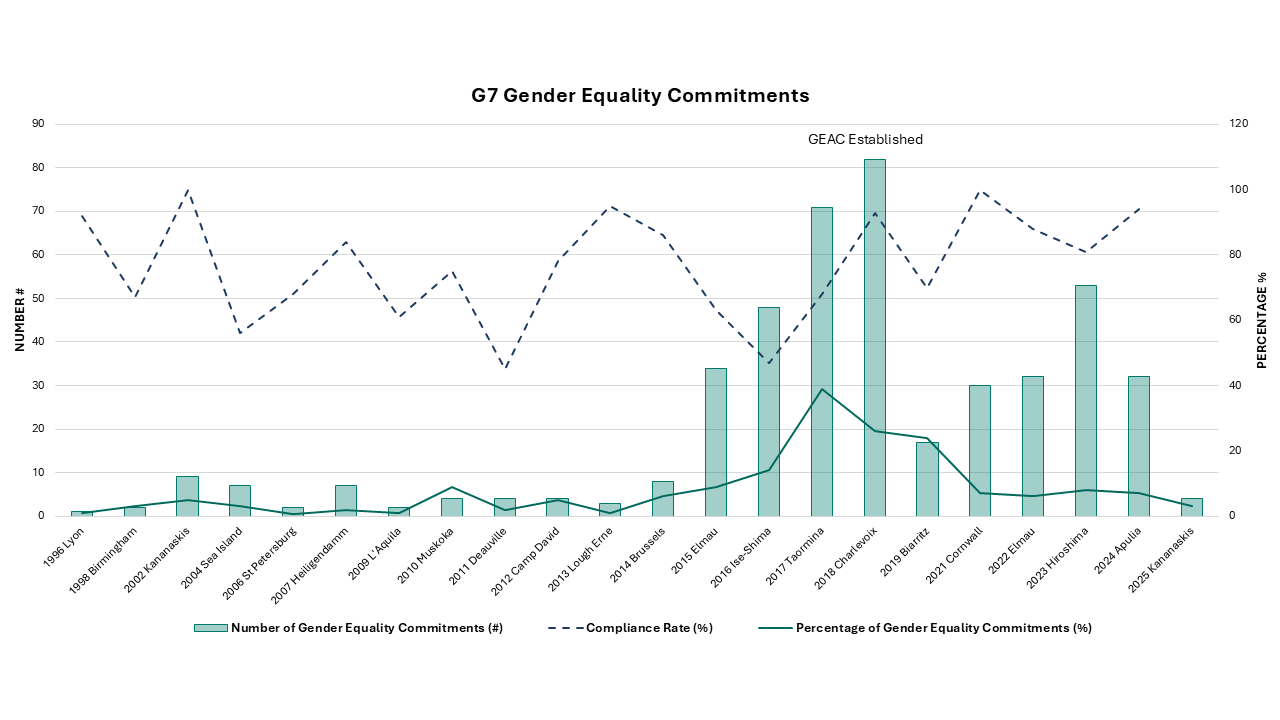
Chart 1. Graph Description
There is a note above the 2018 Charlevoix summit that reads “GEAC Established,” marking the creation of the Gender Equality Advisory Council and coinciding with the sharp rise in commitments. Overall, the chart shows that gender equality commitments were minimal before 2016, that they surged dramatically after GEAC was established in 2018, and that compliance rates remained variable throughout the period. |
Although the assessment covered only the first GEAC cycle (2018 to 2024), it notes that gender also received some attention in 2025, with leaders making 4 gender equality commitments at the 2025 Kananaskis summit.
Just as the number of gender equality commitments has shifted over time, so has the rate of the G7’s compliance with these commitments. The G7 Research Group analyzes G7 compliance with commitments by looking at G7 members’ compliance over the one-year period following the summit. It uses a three-point scale.4 According to its research, compliance with gender equality commitments averages 75% but has shifted greatly over the years, although this is not necessarily related to the number of commitments made. For example, compliance was at 47% in 2016, 93% in 2018 and 100% in 2021. Although the impact assessment did not explore GEAC’s impact on actual results “on the ground,” according to research, holding a gender equality ministerial meeting before the summit and the existence of gender-related institutional bodies like GEAC have had a positive impact on compliance.5 Other catalysts include leaders setting concrete targets, allocating funding to their commitments and complementing commitments with language on implementation, references to prior summit commitments and supporting data.
A text comparison between GEAC’s recommendations and leader-level outcome documents for the 2018 to 2024 period demonstrates a notable overlap in terms of GEAC’s recommendations and the leaders’ gender equality commitments. Each year (except 2020), leaders made commitments in some of the gender equality areas that GEAC addressed, which shows there is a correlation between GEAC’s recommendations and G7 commitments. These commitments were related to education, science, technology, engineering and mathematics (STEM) and digital inclusion, women’s economic empowerment, sexual and gender-based violence, including in conflict and digital contexts, climate change and the care economy, among other things. GEAC’s recommendations are listed in Annex?B.
In several of these areas, the language was specific enough to indicate causality, and stakeholder interviews confirmed that a GEAC recommendation had translated directly into leader-level commitments or actions in some instances.
In 2021, GEAC recommended the development of a new international convention to address conflict-related sexual violence. In response, the G7 leaders invited Foreign and Development ministers to consider how to best strengthen the international architecture around conflict-related sexual violence. The U.K. subsequently led efforts to this effect. Although it could not secure international support for a new convention, it took other initiatives to strengthen the global response to conflict-related sexual violence within its Preventing Sexual Violence in Conflict Initiative.
In 2021, GEAC also stressed the importance of rebuilding global education for girls in the wake of the COVID-19 pandemic. Prime Minister Boris Johnson of the U.K. pledged £430 million in new aid to help children who were the most vulnerable, particularly girls, access to school, and he used the first session of the G7 summit to rally world leaders to “build back better for all.”
“The challenges we discussed in Carbis Bay this summer—of building back better from Coronavirus, and creating a greener, more prosperous future for us all—will simply not be met if half the world’s people are unable to play their part, which is why I convened a Gender Equality Advisory Council to help put women and girls at the heart of the U.K.’s G7 Presidency. I’m enormously grateful to everyone involved for helping us do just that, particularly GEAC Chair Sarah Sands and Nobel laureate Dr. Denis Mukwege for addressing us at the summit back in June. And I’m delighted to see the concrete G7 commitments that came about as a result, including on tackling sexual violence in conflict, boosting the number of girls in school and fixing the under-representation of women in STEM.”
— The Right Honourable Boris Johnson, Prime Minister of the United Kingdom
In 2022, GEAC’s repeated recommendation to measure G7 progress on advancing gender equality translated into a leader-level commitment to establish the G7 Dashboard on Gender Gaps (which W7 had also recommended). The dashboard was established in 2022 and has produced annual data ever since. It is a collaboration between the G7 Presidency and the Organisation for Economic Co-operation and Development (OECD).
“I am grateful to the G7 Gender Equality Advisory Council (GEAC) for providing us with the impetus to develop this highly relevant and timely tool [G7 Dashboard on Gender Gaps]. We need humanity’s full potential for the tasks that lie ahead of us, potential that includes the strength, the ideas, and the knowledge of the world’s four billion women and girls.”
— Olaf Scholz, Chancellor of the Federal Republic of Germany
| The G7 Dashboard on Gender Gaps, adopted in 2022, uses a framework of agreed indicators to measure G7 progress on gender equality commitments and identify remaining gaps. It is updated annually by the OECD in collaboration with the G7 Presidency. |
In a few other instances, the language in the leaders’ commitments was specific enough to suggest causation or, at least, demonstrate a strong correlation with GEAC recommendations. For example, in 2018, GEAC called on G7 leaders to “provide policy and funding support to developing and conflict-affected countries to improve access to a minimum of 12 years of free, safe, quality and gender-responsive education.” This aligned with the recommendations of GEAC member Malala Yousafzai, a global advocate for girls’ education. That same year, G7 leaders adopted the landmark Charlevoix Declaration on Quality Education for Girls, Adolescent Girls and Women in Developing Countries, and committed to increase access to at least 12 years of education for all and to dismantle the barriers to girls’ and women’s quality education, particularly in emergencies and in conflict-affected and fragile states. In 2021, GEAC recommended that G7 leaders support the Equal by 30 Campaign, which was launched in 2018 with the support of then-GEAC co-chair Isabelle Hudon. The 2021 summit communiqué subsequently noted: “We will continue our efforts to progress the Equal by 30 Campaign for gender equality in the energy sector.”
While the assessment focuses on the leaders’ track, it also notes examples of significant overlap between GEAC’s recommendations and commitments made at the ministerial level; in some cases, these indicated correlation. Most notably, ministers responsible for gender equality have made commitments that align with GEAC’s priorities, including commitments related to care work, women’s economic empowerment, and sexual and reproductive health and rights. These ministers have also mentioned GEAC in their commitments and welcomed its recommendations. For instance, in 2019, gender ministers said they would “work towards a Partnership for Gender Equality, with support from the Gender Equality Advisory Council, aimed at making individual commitments towards improving the legal and policy framework.”
In addition to GEAC’s recommendations, there are several factors that contribute to the development of G7 gender equality commitments. Most importantly, the agenda is shaped by the G7 presidency, which plays a key role in deciding whether gender equality will be a focus—as it was in 2018 and 2019—and, if so, which gender gaps will be addressed. Given that the G7 is a consensus-based group, these decisions go beyond the G7 Presidency’s own values and priorities, and encompass those of other G7 members. The G7 agenda and final outcomes are also informed by external stakeholders, including, for example, G7 engagement groups like the W7.
GEAC’s efficacy also depends on the level of support it receives from the G7 Presidency, which determines how much information is shared with GEAC, including information related to G7 priorities and initiatives. Access to this information early on allows GEAC to align its recommendations with the G7 agenda, thereby increasing the chances of uptake. The G7 Presidency also determines how much access GEAC has to G7 decision makers, including leaders, ministers, sherpas and other senior officials. It also determines whether GEAC members will be invited to review draft outcome documents. The assessment shows that access in both instances is essential for GEAC to have an impact. For example, during Canada’s 2018 G7 Presidency, GEAC members were asked to sign confidentiality and non-disclosure agreements so they could have access to priorities before they were made public, and could review draft outcome documents. Finally, the G7 Presidency produces the zero drafts and leads the negotiation of G7 outcome documents, and therefore plays a critical role in deciding to what extent GEAC recommendations are translated into G7 commitments.
Although the assessment demonstrates that GEAC can influence outcomes, ultimately, no matter how accomplished and engaged its members are, its influence depends on the support and receptivity of the G7 Presidency and other G7 members.
The assessment also shows that GEAC provides a unique platform for discussing gender equality issues within the G7. Once GEAC is convened, there is an expectation that the G7 will consider the gendered dimensions of issues on its agenda, which adds a level of pressure on the G7 Presidency to deliver concrete outcomes. But GEAC also helps keep these issues on the agenda, regardless of actual outcomes.
Finally, the fact that GEAC is convened year after year can be interpreted as confirmation of the G7’s fundamental commitment to gender equality during the period covered by this assessment.
“We, Leaders, recognize that gender equality is fundamental to full and equal enjoyment of all human rights and the achievement of sustainable development and peace. We welcome the Paris Declaration on Gender Equality adopted by Ministers for Gender Equality of the G7 in May 2019. We were briefed by representatives from the Gender Equality Advisory Council. We underline the importance of meaningful consultation with the civil society at large to address good practices of new and innovative laws for gender equality.”
— G7 Leaders’ Declaration on Gender Equality and Women’s Empowerment
Stakeholders identified numerous strengths and challenges that shape GEAC’s effectiveness.
Unique mandate: GEAC’s mandate is unique and valuable to the G7. Its advisory function complements the advocacy work of G7 engagement groups, including the W7. GEAC’s proximity to the G7 Presidency, the fact that its recommendations are directed primarily at leaders and the public profile of some of its members all create leverage. When GEAC works as intended, it both informs and expands space for a gender equality discussion at the G7 table and demonstrates to the world what feminism can look like on the global stage. GEAC’s potential to support gender mainstreaming across G7 initiatives can help ensure better outcomes for all. To support its recommendations, GEAC gathers data on gender gaps in the G7, in addition to the data tracked by the dashboard, and advises the G7 on how to tackle these inequalities. Finally, the fact that G7 members are relatively like-minded and have comparable challenges to achieving gender equality creates a context that is exceptionally conducive to mutual learning and coordinated action.
Independent expertise: While uniquely positioned, GEAC is independent. It serves as a centre of expertise that highlights issues of concern through its recommendations and reports, and through the public-facing statement it issued in the context of COVID-19 in 2020.6
Members’ diversity and public profile: GEAC’s diverse membership from various sectors (including business, academia, civil society and government), geographic regions and, most years, genders contributes to the legitimacy of its recommendations. The fact that members are renowned and well-connected experts in their fields, many with public profiles, creates opportunities for public outreach, facilitates access to G7 decision makers, including leaders and ministers, and lends its recommendations more weight, increasing the chances of their uptake. GEAC’s broad and multidisciplinary expertise, and the G7 Presidency’s prerogative in selecting members, also means it can align its recommendations with G7 priorities—which change from year to year with the rotating presidencies—and ensures it is well positioned to support gender mainstreaming across the G7 agenda.
Lever of accountability: As previously discussed, the G7 Dashboard on Gender Gaps, championed by GEAC, introduced a monitoring and accountability system that focuses on gender equality and complements the G7 Accountability Working Group and its annual reports. But GEAC is also a lever of accountability: once it is convened, there is an expectation that the G7 will consider gender issues, which adds a level of pressure on the presidency to deliver concrete outcomes, reinforced by the public nature of its recommendations. More broadly, GEAC helps ensure that gender equality remains on the G7 agenda. Even when gender equality is not a stand-alone priority on the G7 agenda or GEAC’s recommendations have a limited influence over G7 leaders’ and ministers’ outcomes, GEAC helps keep the conversation going, even if it is behind closed doors. The fact that GEAC is still around after 7 years is, in a way, a success in itself, demonstrating that, over the assessment period, the G7 recognized the centrality and importance of gender equality, including in relation to the other issues on the G7 agenda.
“You cannot implement what you cannot measure.”
— Isabelle Hudon, 2018 GEAC Chair
Timelines: The annual process of nominating and appointing members is time consuming and often results in GEAC being convened months into the G7 Presidency. This limits GEAC’s ability to develop solid recommendations ahead of the leaders’ summit, which is held midway into the presidency year. The timelines also limit the usefulness of GEAC’s reports, which elaborate on its recommendations, and provide data and case studies, among other things. While these reports are strong reference documents that can be used by future G7 presidencies and other international forums, they are usually finalized at the end of the year, which is too late to influence G7 outcomes.
Resources: Given the honorary basis for GEAC membership, financial resources to support GEAC members’ travel to G7 and GEAC meetings are essential. In years when funding has not been available, members have noted a negative impact in terms of GEAC’s engagement and results. GEAC members who are expected to cover their own expenses are effectively being asked to “pay for their voice.” Members also perceive a lack of resources to support GEAC’s work as a lack of interest from the G7 Presidency to advance gender equality. Resources to create a GEAC secretariat, which can in turn support GEAC, are also critical. Women make up an overwhelming majority of GEAC membership, so having targeted resources to support GEAC’s work could also help combat a stubborn cultural bias regarding the value of women’s work.
Communications: The absence of a continuous and dedicated GEAC website to act as a repository and preserve the corporate history of GEAC’s work limits its reach and efficiency. GEAC’s reach is further limited in years when there is no communication strategy to promote its recommendations.
Membership: Given that membership is non-remunerated, with expertise offered on a voluntary basis, member participation in meetings and working groups varies, limiting the scope of expertise and resulting in an uneven distribution of work among members. While GEAC’s cross-sectoral membership—which includes people from academia and the private sector—is a strength, this also means that individual members sometimes lack experience in multilateral policy or advocacy work.
As part of the assessment, stakeholders identified several recommendations to maximize GEAC’s impact and ensure stronger gender equality outcomes in the G7.
Convene GEAC as early as possible in the presidency year to give it sufficient time to prepare recommendations ahead of the leaders’ summit.
Establish a dedicated GEAC Secretariat that is co-located with the presidency’s sherpa team to ensure GEAC’s access but maintains its independence. Establish it at the same time as the sherpa team’s other units to allow alignment and access from the very beginning.
Equip the GEAC Secretariat with sufficient human and financial resources to adequately support GEAC’s work, including the resources needed to allow members to attend G7 and GEAC in-person meetings, and, as required, to develop a dedicated website.
Ensure there is a consistent and an open flow of information about the G7’s agenda and priorities to ensure GEAC can make informed decisions about the focus of its recommendations.
Support GEAC’s participation in all G7 tracks (from working groups and ministerial tracks to sherpas and the leaders’ track) to support the mainstreaming of gender equality across the G7, and ensure that tracks involved in delivering presidency priorities are well briefed on GEAC’s mandate and connected with the GEAC Secretariat.
Consider supporting a dedicated, independently maintained website to ensure that GEAC’s recommendations and reports are easily accessible to future presidencies and to the public. This could increase GEAC’s impact, ensure continuity from year to year and promote the G7’s commitment to gender equality. This could also help raise awareness about GEAC more broadly, as it is not well known or understood beyond those who are directly involved.
Develop a communication strategy to promote GEAC’s recommendations.
Invite GEAC to support the continued development and updating of the dashboard’s indicators.
Incorporate the dashboard’s data into GEAC’s annual reports consistently and continuously to strengthen G7 monitoring and accountability.
Discuss the lack of comparable data across the G7 in critical areas, such as the equal sharing of unpaid work between women and men, a comprehensive definition of gender-based violence and women in AI, with the aim of having all G7 members collect this data.
Provide GEAC with secretarial support, including by organizing GEAC meetings (working group meetings and meetings between all members) and supporting the development of its recommendations, while working in tandem with the GEAC Chair and working groups, which lead on developing the recommendations.
Organize at least one in-person GEAC meeting as early as possible in the year, as this is vital for establishing a cohesive and productive working dynamic.
Act as a bridge between GEAC and the G7 Presidency to ensure GEAC has access to relevant G7 meetings, including ministerial meetings and the leaders’ summit, and to draft G7 statements and other outcome documents so it can provide input ahead of text negotiations.
Work strategically to ensure GEAC’s expertise is translated into relevant recommendations that can influence policy outcomes.
Clearly define the roles and expectations of GEAC chairs and members when they are invited to join GEAC, so they are aware of the time and effort required.
When selecting GEAC members, prioritize expertise that is relevant to the focus and objectives of the G7 Presidency agenda; this will allow for an analysis of gender perspectives in G7 thematic priority areas and support gender mainstreaming.
Appoint members who are renowned and well connected in their fields of expertise and ensure that at least the chair has a public profile; this will ensure access to decision makers, including at the leaders’ level, and increase influence.
Encourage G7 members to nominate diverse members—including men who are allies and individuals from the Global South—which will help counter the false narrative that gender is a western construct and a women’s-only issue, and will increase GEAC’s legitimacy.
Strive to include previous and new members to ensure continuity as well as expertise that is relevant to the annual G7 agenda. The current terms of reference, which allow for the appointment of 8 GEAC members for 2-year terms, can help address the timeliness issue by allowing the G7 Presidency to engage with GEAC earlier; they also address continuity, as having 2-year members facilitates the faster organization of GEAC’s agenda and working methods. Ideally, appointments of 2-year members would be staggered in order to maximize overlap and ongoing continuity between presidencies.
Appoint at least one W7 representative to GEAC to serve as a link between gender equality advocacy and grassroots constituencies, and to ensure that GEAC and the W7 can support each other’s efforts. To that end, regularized consultations with the W7 should be established, for example by encouraging GEAC members to liaise with their respective countries’ W7 representatives when providing input.
Organize an in-person GEAC meeting early in the G7 Presidency year to establish a strong rapport and productive work dynamic between members from the start.
Initiate the work to develop recommendations as soon as possible to allow GEAC to finalize them ahead of the leaders’ summit.
Strive to include as many GEAC members as possible in G7 meetings to increase representation and the diversity of voices around the table, ultimately maximizing impact.
Encourage and support GEAC members’ advocacy with their governments, in particular members who are nominated by G7 members and may have access to their countries’ sherpa teams, which will support the uptake of GEAC recommendations. This advocacy should be included in the role description in the GEAC membership invitation letter.
Consider whether annual reports are valuable tools, given the amount of time they take to draft and their limited dissemination, lack of follow-up discussions and late publication—after key events like the summit and ministerial meetings—which reduce their impact. As earlier publication may be difficult due to condensed timelines, developing a communication strategy that enhances the report’s visibility could boost its value.
Develop a practical guide, which could be adopted by G7 officials, that would complement GEAC’s terms of reference and include timelines for establishing a secretariat, parameters for financial support, meeting tempo and confidentiality agreements, among other things. This would ensure consistent and adequate support for GEAC’s operations, and maximize its effectiveness and value added to the G7 Presidency.
Play a leadership role in developing a clear, focused and cohesive vision for GEAC, and actively and consistently engage with the Secretariat and sherpa team, including at the sherpa level, ideally beginning in January, to advocate for and deliver on GEAC’s mandate.
Ensure that GEAC members are well informed of the G7 Presidency’s priorities to help define the scope of GEAC’s work and maximize its relevance and impact.
Guide members in developing targeted, realistic and focused recommendations—less is more.
Consider public outreach, including through traditional media and the effective use of social media, to increase awareness of gender equality work and G7 accountability, and to promote a feminist perspective.
Commit to intersectionality to ensure the needs of all genders are reflected in GEAC’s recommendations. Acknowledging the challenges of other groups facing discrimination helps encourage joint and coordinated action with stakeholders working to advance gender equality, including activists and practitioners.
Consider broadening GEAC’s reach beyond the G7 to include engagement with the UN Commission on the Status of Women, decision makers in non-G7 countries and civil society, including regular consultation with relevant G7 engagement groups. This could raise awareness of GEAC’s work and the G7’s efforts to close gender gaps.
Did the G7 Presidency articulate a clear vision for GEAC’s role and participation modality?
In your view, how effective was GEAC in ensuring that gender equality considerations were part of the G7 Presidency process and outcomes? Did you feel that GEAC’s work/recommendations influenced/were relevant in terms of ministerial- or leader-level commitments and outcomes? Can you give any specific examples?
If yes, what factors supported the achievement of these results (for example, organizational elements in terms of access to decision makers and ability to advocate for GEAC, frequency or format of meetings, access to decision makers, secretarial support, influence of individual GEAC members and collaboration with civil society)?
If no, what were the barriers?
What are GEAC’s greatest strengths? What areas could be improved?
In the context of the growing backlash against progressive gender equality goals in various multilateral forums, how important and relevant is GEAC to the G7’s work and why?
Do you have any other comments you would like to share with us?
Make Gender Inequality History: Recommendations from the Gender Equality Advisory Council for Canada’s G7 Presidency Canada, June 2018
Biarritz Partnership for Gender Equality: Recommendations of the Gender Equality Advisory Council for Advancing Gender Equality and the Empowerment of Girls and Women and Call to Action – France, August 2019
Step It Up G7: An Extraordinary Time Requires Extraordinary Solidarity — Statement by GEAC Members 2018–2019 – U.S., April 2020
Recommendations of the Gender Equality Advisory Council 2021 to the Leaders of the G7 – U.K., June 2021
GEAC Report 2022: A Shared Vision for Gender Equality Germany, December 2022
Gender Mainstreaming for an Inclusive, Peaceful and Just Society: 2023 GEAC Recommendations to the G7 Leaders Japan, May 2023
World Needs Women’s Leadership and Experience: 2024 GEAC Recommendations Italy, June 2024
Recommendations from the GEAC to G7 Leaders: Take Action for an Equal, Secure and Prosperous Future Canada, June 2025
Source: Official website of Canada's 2025 G7 presidency
 — 
|
This Information System is provided by the University of Toronto Libraries and the G7 Research Group at the University of Toronto. |
|
Please send comments to:
g7@utoronto.ca This page was last updated April 12, 2026. |
 |
 |
 |
 |
All contents copyright © 2026. University of Toronto unless otherwise stated. All rights reserved.